




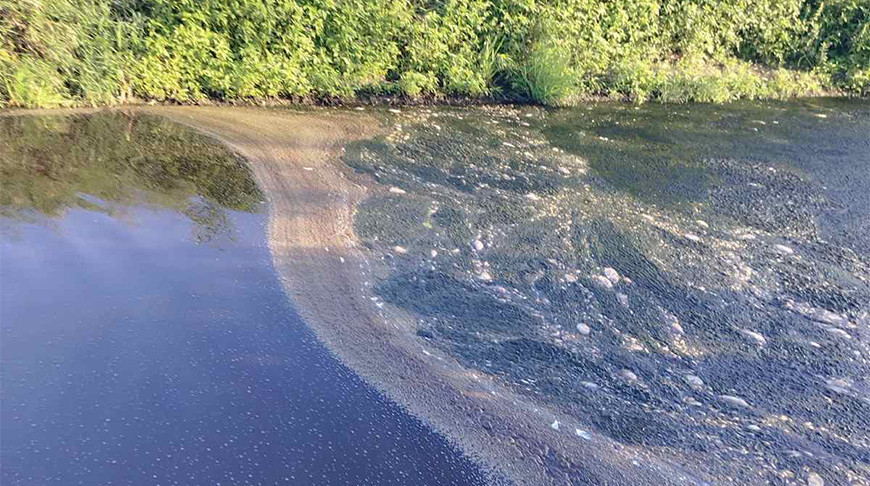
Water levels are declining in water bodies across Brest Oblast and nationwide. This is due to natural factors, the Brest regional committee for natural resources and environmental protection told BelTA.
Specialists note that low water levels are a general trend for most water bodies in the region. “The shallowing is a consequence of a precipitation deficit, which has been observed for the third consecutive year. In some areas, not only rivers and lakes but also wells have become shallower. The deficit has been observed throughout 2026,” the committee explained.
Heavy summer downpours can also pose a danger. “During hot weather, overheated water rich in organic matter can rush into water bodies from floodplains in large surges, potentially leading to mass fish deaths,” the committee noted.
The decline in water levels is especially noticeable on the Pripyat River and Yaselda River and large reservoirs used to fill fish ponds at fish farms. “On the watercourses that are part of the Dnieper–Bug waterway system, water levels are maintained artificially with the help of locks to ensure navigation. However, even with regulation, flow remains low, leading to water blooming and the active growth of algae,” the committee specified.
Specialists emphasize that under the current conditions, attempts to deepen a pond or clean its bottom will not solve the problem. “If the impermeable layer on the bottom of a water body is disturbed when groundwater levels are low, the remaining water can quickly drain away. Intervention could only make the situation worse,” the committee explained.
According to specialists, complaints are being received from the public: people are noting that water is receding from the shores, blooming, and in some ponds and wells, it is becoming critically scarce. “This is not an environmental catastrophe, but a natural process that can only be influenced by weather. The situation is similar in many European countries. It is impossible to significantly prevent shallowing at a time of precipitation deficit. Specialists are monitoring water bodies and, if necessary, taking measures to prevent fish kills caused by oxygen depletion,” the committee added.
Specialists note that low water levels are a general trend for most water bodies in the region. “The shallowing is a consequence of a precipitation deficit, which has been observed for the third consecutive year. In some areas, not only rivers and lakes but also wells have become shallower. The deficit has been observed throughout 2026,” the committee explained.
Heavy summer downpours can also pose a danger. “During hot weather, overheated water rich in organic matter can rush into water bodies from floodplains in large surges, potentially leading to mass fish deaths,” the committee noted.
The decline in water levels is especially noticeable on the Pripyat River and Yaselda River and large reservoirs used to fill fish ponds at fish farms. “On the watercourses that are part of the Dnieper–Bug waterway system, water levels are maintained artificially with the help of locks to ensure navigation. However, even with regulation, flow remains low, leading to water blooming and the active growth of algae,” the committee specified.
Specialists emphasize that under the current conditions, attempts to deepen a pond or clean its bottom will not solve the problem. “If the impermeable layer on the bottom of a water body is disturbed when groundwater levels are low, the remaining water can quickly drain away. Intervention could only make the situation worse,” the committee explained.
According to specialists, complaints are being received from the public: people are noting that water is receding from the shores, blooming, and in some ponds and wells, it is becoming critically scarce. “This is not an environmental catastrophe, but a natural process that can only be influenced by weather. The situation is similar in many European countries. It is impossible to significantly prevent shallowing at a time of precipitation deficit. Specialists are monitoring water bodies and, if necessary, taking measures to prevent fish kills caused by oxygen depletion,” the committee added.